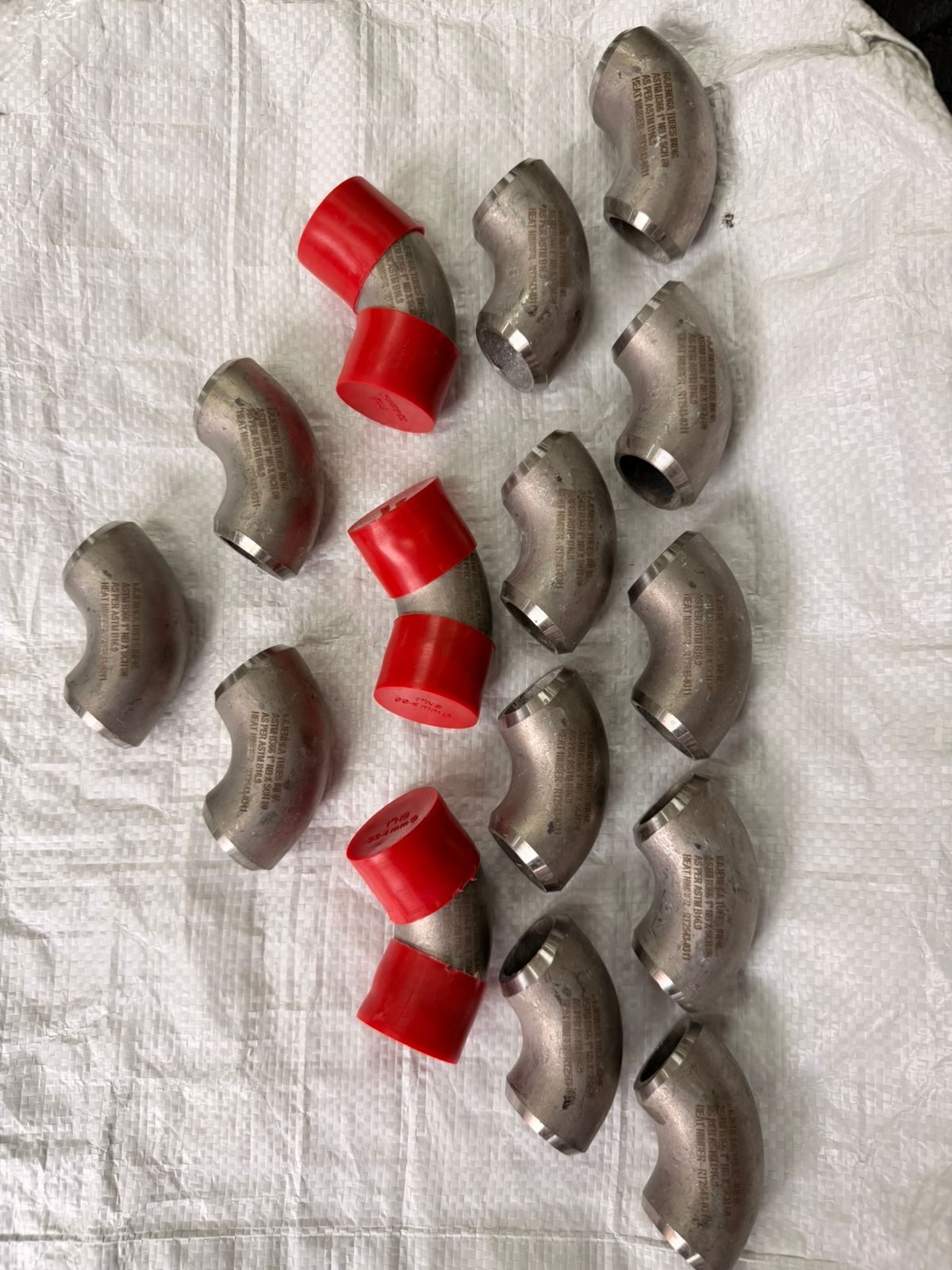
90° Elbow (LR / SR)
Long radius is 1.5 × NPS and is the default; short radius is 1.0 × NPS where space is tight.
| Types | Elbow 45° / 90° / 180° (long and short radius) · Tee equal and reducing · Reducer concentric and eccentric · Cap · Stub End · Cross |
|---|---|
| Grades | Carbon ASTM A234 WPB / WPC · Stainless ASTM A403 WP304L, WP316L, WP321, WP347, WP310S · Duplex ASTM A815 UNS S31803, S32205, S32750, S32760 · Nickel Alloy ASTM B366 Inconel, Monel, Hastelloy, Incoloy |
| Sizes / NPS Range | NPS 1/2" to 24" · larger sizes fabricated to drawing |
| Schedules / Thickness | Sch. 5S to XXS, matched to the connecting pipe |
| Standards | ASME B16.9 · MSS SP-43 · MSS SP-75 · ASTM A234 / A403 / A815 / B366 |
| Ends | Bevelled to ASME B16.25 for butt welding |
| Finish | Pickled & passivated · Shot blasted · Painted (carbon steel) |
| Certification | MTC to EN 10204 3.1 · NACE MR0175 / ISO 15156 on request |
Long radius is 1.5 × NPS and is the default; short radius is 1.0 × NPS where space is tight.
Used to ease a change of direction and reduce pressure drop against two 90° turns.
Reverses flow in a compact footprint — common in heater and exchanger coils.
Branch connection at full or reduced bore, forged or formed to the run schedule.
Shares a centreline. Standard for vertical runs and pump discharge.
Shares one tangent line. Used in horizontal runs to keep a flat top or flat bottom and avoid trapping vapour or liquid.
Closes a line end for pressure testing or future tie-in.
Used with a lap joint flange so the flange can rotate freely for bolt alignment.
A butt weld fitting is welded end to end with the pipe, so the bore is continuous and there is no crevice, no thread and no gasket. That gives the smoothest flow path, the highest strength and the best fatigue life of any fitting type, and it is why butt welding is the default above NPS 2 in process piping. The cost is that the joint is permanent and requires a qualified welder.
Dimensions are fixed by ASME B16.9: centre-to-end lengths, wall thickness tolerance and marking. Because the standard is dimensional, a B16.9 fitting from any compliant maker will match the pipe it is welded to, provided you have matched the schedule.
A butt weld fitting must be ordered to the same schedule as the pipe it joins, because the standard requires the bores to line up within a tolerance. If they do not, you get a step in the bore: a stress raiser, a turbulence source and, in hygienic or slurry service, a place for material to collect. Ordering a Sch 40 elbow for a Sch 80 line is the single most common mistake we see, and it is discovered at fit-up, when it is expensive.
A long radius (LR) elbow has a centreline radius of 1.5 × NPS; a short radius (SR) elbow has 1.0 × NPS. Long radius is the default and should stay the default: it produces less pressure drop, less turbulence and less erosion. Short radius exists for genuinely tight installations. In erosive or slurry service, use long radius and consider a larger radius bend instead.
This choice has a practical consequence that catches people out. A concentric reducer keeps both ends on the same centreline and is correct for vertical runs. An eccentric reducer keeps one tangent line straight, and in horizontal runs that matters:
Putting a concentric reducer on a horizontal pump suction is a classic cause of cavitation complaints that get blamed on the pump.
A stub end is butt welded to the pipe and a lap joint flange sits loose behind its lap, free to rotate. It solves two problems: bolt holes can be aligned on site without rotating the whole spool, and in expensive alloys only the stub end needs to be alloy while the backing flange can be carbon steel. On a 904L or Inconel line that is a substantial saving.
Carbon fittings are supplied to ASTM A234 WPB, stainless to ASTM A403 (WP304L, WP316L, WP321, WP347, WP310S), duplex to ASTM A815 and nickel alloys to ASTM B366. Fittings are formed hot or cold and then solution annealed, which matters for austenitic grades: forming work-hardens the material and reduces corrosion resistance, and annealing restores it. Ends are bevelled to ASME B16.25 ready for welding.
Every fitting is supplied with a Material Test Certificate to EN 10204 3.1. For sour service, NACE compliance covers hardness after forming and heat treatment, so it must be specified before manufacture, not requested afterwards.
Fitting type and angle, NPS, schedule, grade and standard, radius (LR or SR), quantity, and certification level. For reducers, state the large and small NPS and whether concentric or eccentric. If you are working from an isometric, send it — it is faster and it removes the guesswork.
Yes. ASME B16.9 requires the bores to line up within tolerance, so a fitting must be ordered to the same schedule as the pipe it joins. Ordering a Sch 40 elbow for a Sch 80 line is the most common ordering error we see, and it is usually discovered at fit-up.
Long radius, at 1.5 times NPS, is the default and produces less pressure drop, turbulence and erosion. Short radius at 1.0 times NPS exists for genuinely tight installations. In erosive or slurry service, use long radius or a larger bend.
Yes. Every consignment is supplied with a Material Test Certificate to EN 10204 3.1 as standard, stating the actual chemical and mechanical results for the heat supplied. EN 10204 3.2, countersigned by an independent third-party inspector, is available if your specification requires it — tell us at enquiry stage, because it affects mill selection and lead time.
There is no fixed minimum. We supply single lengths and single fittings from stock as readily as full project quantities. For grades we import to order, the mill will set its own minimum, and we will tell you what that is when we quote.
Yes. Alongside standard sizes we manufacture and fabricate to drawing. Send the dimensions, the material specification and the end preparation, and we will quote against them. If you have service conditions rather than a grade, send those and we will recommend a material.
Stock items despatch quickly from Mumbai. Imported grades and fabricated items depend on the mill and the scope of work, so we confirm a firm lead time with every quotation rather than publishing a general figure that would not hold.
Request a quotation
Send the grade, size, schedule and quantity and we will come back with availability, lead time and price. No account, no sign-up.